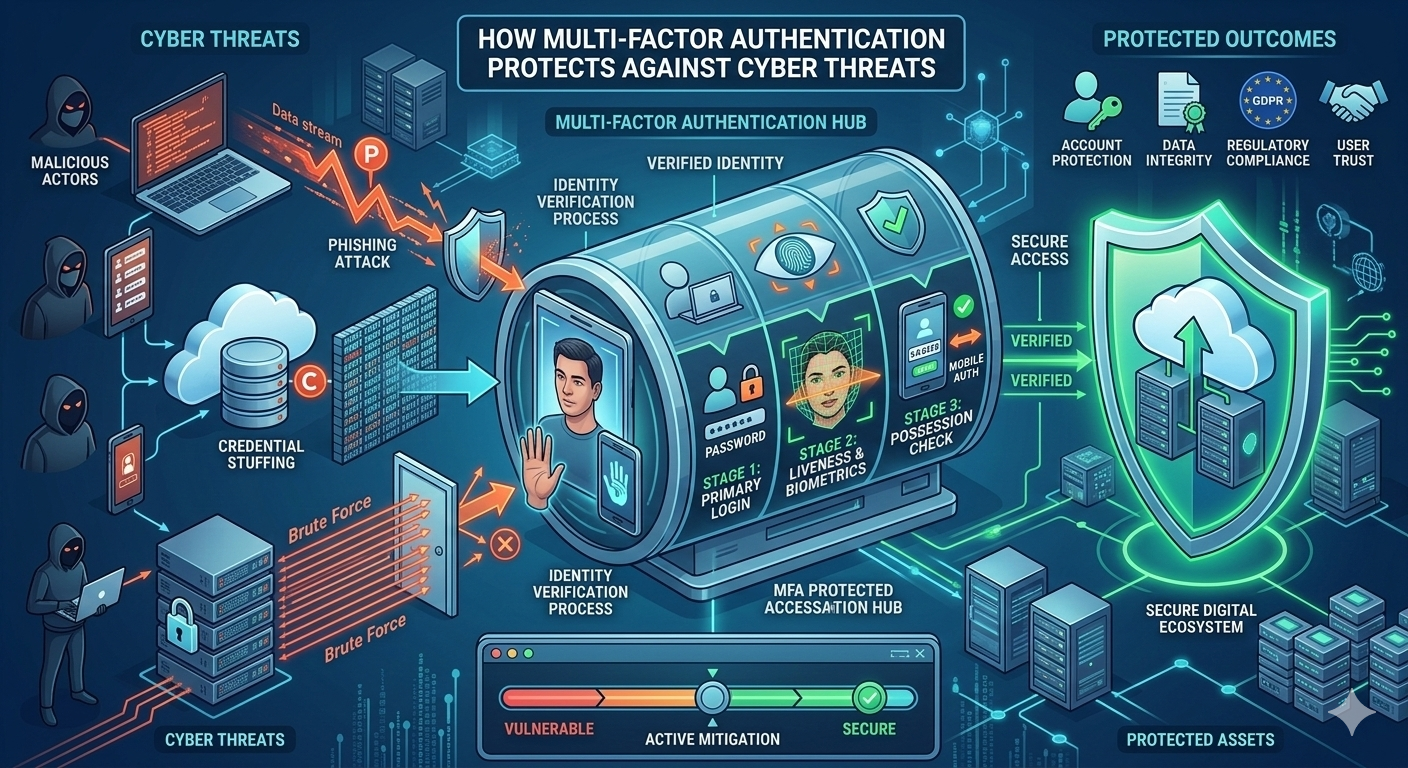
In today’s digital world, cybersecurity is one of the most critical challenges for businesses, organizations, and individuals. Cyber threats such as phishing, ransomware, and account takeovers are becoming increasingly sophisticated. Traditional password-based security is no longer sufficient, making multi-factor authentication (MFA) a key solution for protecting sensitive data and digital assets.
Multi-factor authentication provides an extra layer of security beyond passwords, making it much harder for cybercriminals to gain unauthorized access. Understanding how MFA works, its benefits, and advanced approaches such as passwordless MFA is essential for organizations aiming to strengthen their defenses.
Understanding Multi-Factor Authentication
Multi-factor authentication is a method that requires users to provide two or more verification factors when accessing an account or system. Unlike traditional single-factor authentication, which relies only on a password, MFA combines multiple forms of verification. Common factors include something the user knows (password or PIN), something the user has (smartphone, security key), or something the user is (biometric identifiers like fingerprints or facial recognition).
This layered approach helps ensure that even if one factor is compromised, unauthorized access is prevented.
Strong Authentication vs Multi-Factor Authentication
Strong authentication improves the security of a single factor, such as using a highly complex password. Multi-factor authentication, on the other hand, adds additional layers of verification. Even if a password is stolen, MFA prevents attackers from accessing accounts without the other factors. This layered approach is highly effective against phishing attacks, credential theft, and account takeovers.
How MFA Protects Against Cyber Threats
One of the primary benefits of MFA is reducing the risk of account takeovers. Cybercriminals often attempt to exploit stolen credentials to access sensitive accounts. With MFA authentication, stolen passwords alone are insufficient because additional verification factors are required. This protects both personal and corporate accounts from unauthorized access.
MFA also mitigates phishing and credential theft. Even if a user unknowingly provides their password in a phishing attack, the attacker cannot bypass the additional verification steps. Organizations that implement passwordless multi-factor authentication add further security while simplifying the user experience.
Remote work introduces additional security challenges, as employees access corporate resources from multiple locations and devices. Multi-factor authentication ensures secure remote access by requiring verification that adapts to device, location, and risk level. It also safeguards sensitive data and transactions in industries such as finance, healthcare, and e-commerce, where preventing unauthorized access is critical.
Advanced MFA and Passwordless Options
Passwordless MFA removes the need for passwords entirely, relying instead on device-based tokens or biometric verification. This approach addresses common issues such as weak passwords, password reuse, and phishing. Combining passwordless multi-factor authentication with traditional factors ensures robust security without compromising usability.
Types of MFA include app-based one-time passwords, hardware tokens, and biometric verification. App-based authentication generates time-limited codes, hardware tokens provide physical verification, and biometric factors such as fingerprints or facial recognition confirm user identity. Passwordless authentication can integrate these methods to reduce reliance on traditional passwords and simplify the authentication process.
Benefits of Multi-Factor Authentication
Implementing MFA provides several advantages. It significantly reduces the risk of account takeovers and phishing attacks while enhancing regulatory compliance in sectors such as finance and healthcare. MFA improves operational efficiency by automating verification processes and creates a secure environment for users. Advanced approaches like passwordless MFA streamline the login experience while maintaining high security standards.
Challenges and Considerations
Despite its benefits, MFA comes with considerations. Some users may find additional verification steps inconvenient, and many MFA methods rely on devices that must be secure and available. Implementing MFA may involve costs and administrative effort, especially with hardware tokens or enterprise-grade solutions. Backup and recovery procedures for lost devices or failed biometrics are essential to maintain continuity without compromising security.
The Future of MFA
Cyber threats continue to evolve, and MFA technology is adapting. Emerging trends include passwordless authentication, adaptive MFA that adjusts requirements based on user behavior or location, AI-powered anomaly detection, and unified authentication across multiple platforms. These innovations aim to provide stronger security while improving usability and efficiency.
Conclusion
Multi-factor authentication is a critical tool in protecting against cyber threats. MFA authentication ensures that even if passwords are compromised, unauthorized access is prevented. Advanced solutions, including passwordless multi-factor authentication, offer robust security while enhancing user experience.
Organizations that adopt MFA can protect sensitive data, reduce the risk of account takeovers, and maintain regulatory compliance. By understanding the differences between strong authentication and multi-factor authentication, businesses can implement the right strategies to secure accounts, systems, and transactions in an increasingly digital world.